IAnversic RAG
Enterprise knowledge retrieval with source-grounded answers
An enterprise knowledge retrieval platform designed to help organizations query internal documents and obtain source-grounded answers while keeping full control over their data and infrastructure.
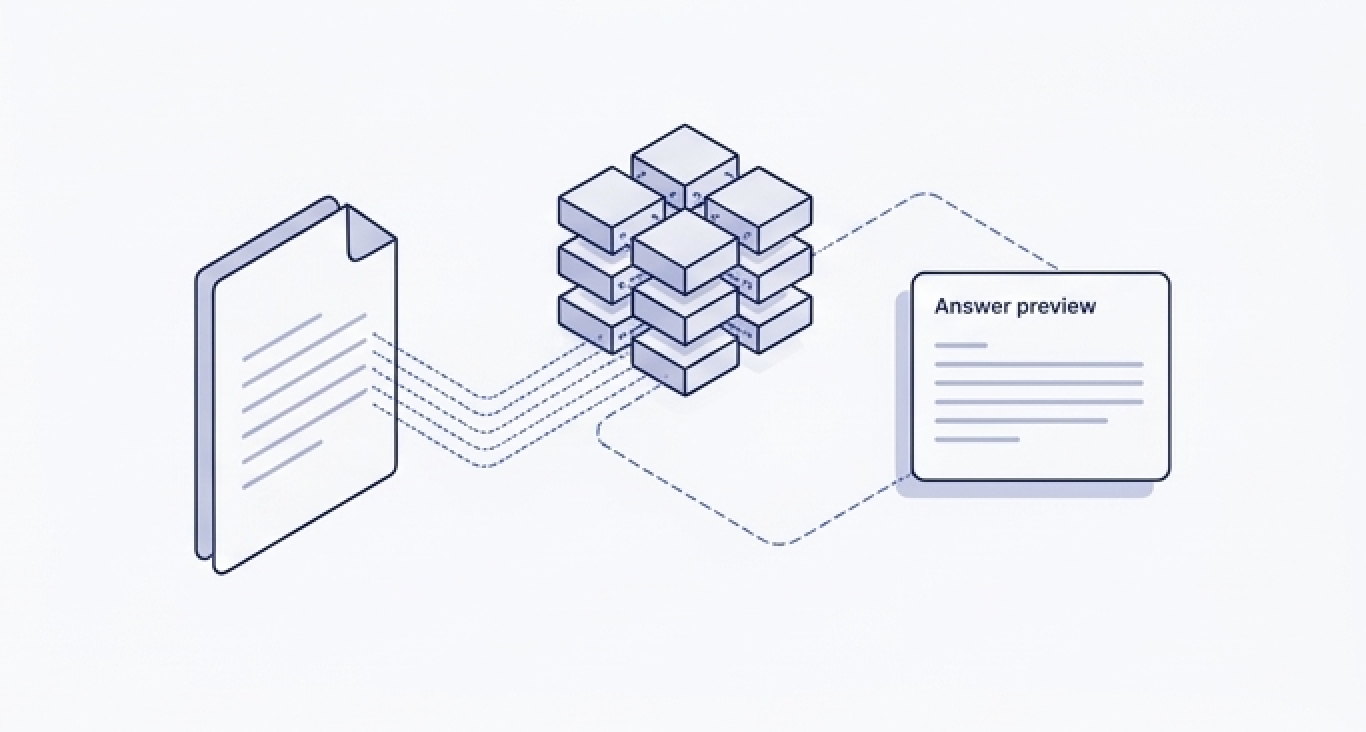
Project overview
The platform explores how organizations can make internal knowledge accessible through AI without giving up control of their documents or infrastructure.
It combines document extraction, semantic search and retrieval-augmented generation to deliver answers grounded in organizational sources, with an engineering focus on private deployment, retrieval quality and source traceability.
Visit live productArchitecture
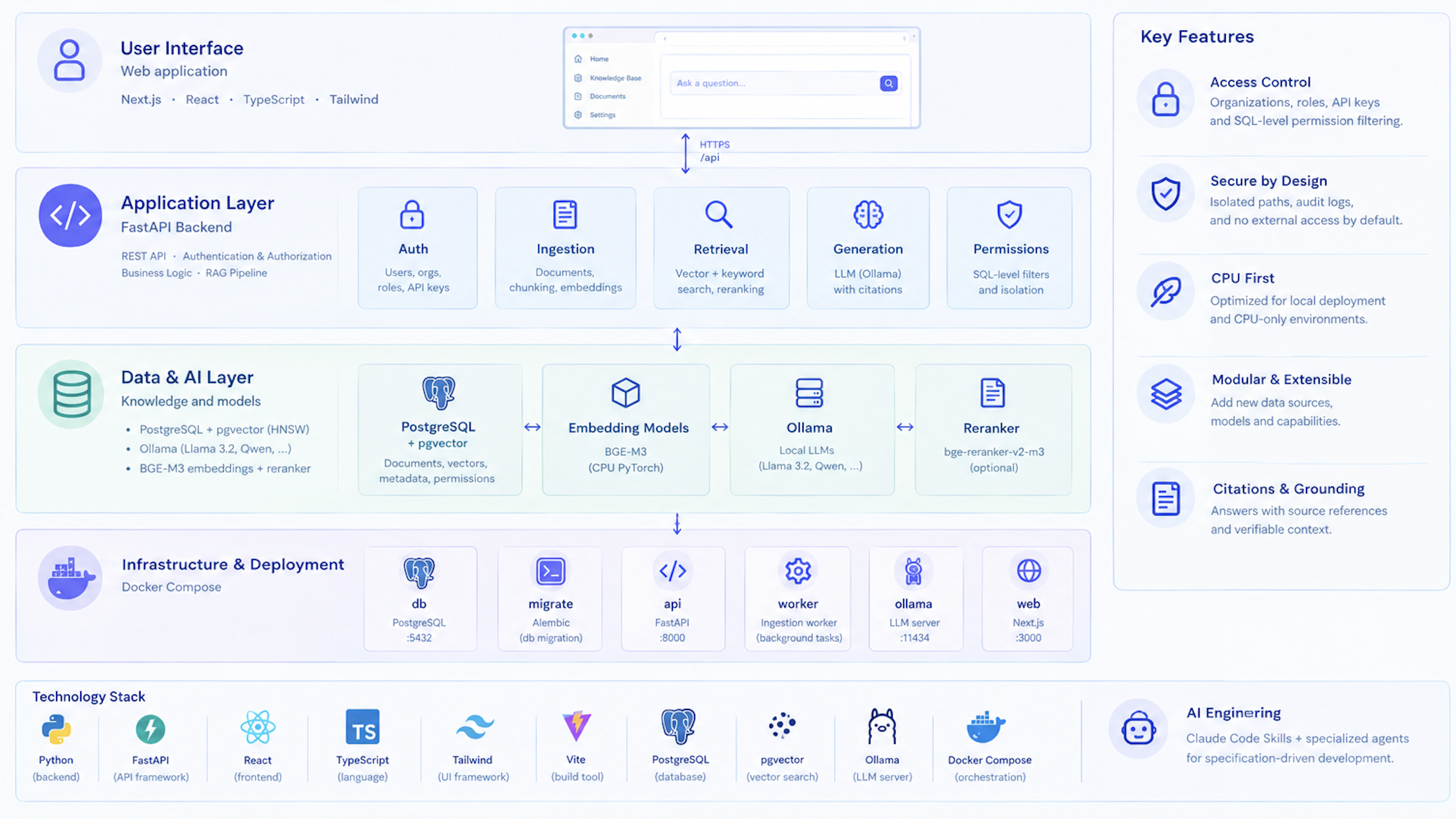
Design decisions
- RAG over fine-tuning for changing enterprise knowledge.
- Hybrid search over vector-only to handle exact identifiers.
- Local models over cloud APIs for privacy guarantees.
Technical challenges
- Preserving tables and headers during chunking.
- Document-level permission filtering in the vector store.
- Running local models on mid-range hardware.
Test Evidence & Validation
Multiple layers of verification across retrieval, security, and the application lifecycle.
IAnversic RAG is validated through automated tests, end-to-end pipeline checks, access-control acceptance tests, and real-model evaluation to verify retrieval behavior, answer grounding, and data isolation.
01Automated Testing
Automated tests verify application logic, retrieval components, security controls, and expected behavior using stub providers and a dedicated test database.
Evidence: test reports, execution output, and relevant test cases.
02End-to-End Pipeline Checks
Smoke tests exercise the core RAG workflow, including authentication, document upload, ingestion, and question answering. Real-model checks evaluate responses using actual embedding and generation models.
Evidence: execution logs, cited responses, expected-versus-actual results, abstention outcomes, and response latency.
03Access-Control Validation
Dedicated acceptance tests verify organization isolation, role-based permissions, API key access, resource visibility, and deactivation behavior.
Evidence: PASS/FAIL results, test execution output, and documented permission scenarios.
04Grounding & Retrieval Quality
Retrieval and answer-generation checks assess whether relevant information reaches the model, generated answers are supported by source documents, citations meet configured grounding requirements, and the system abstains when confidence is insufficient.
Evidence: retrieved chunks, source citations, grounding-check results, abstention cases, and evaluation reports.
Current status & next steps
A complete pipeline of ingestion, hybrid embeddings, reranking and grounded generation with citations is working.
Next: continuous evaluation on larger datasets and latency optimization for local inference.
Contact about this project